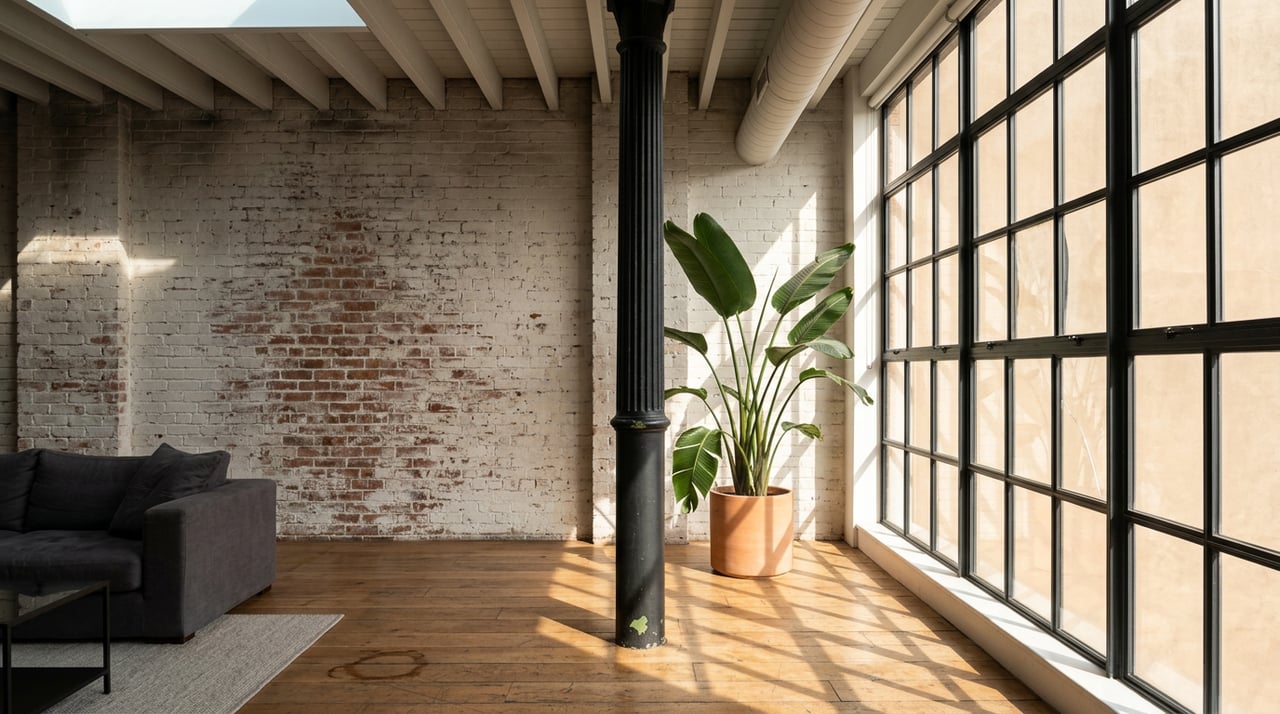
The SoHo Loft Fee the Courts Just Made Permanent
Zigi Ben-Haim has lived in his SoHo loft since 1979. He is an artist, the kind the city's 1971 zoning law was written to protect. Yet this year he found himself asking, in his words, "I'm not sure what we'll do now" about a fee that could cost his estate a quarter million dollars the moment his loft changes hands.
That is the story most SoHo loft guides skip. They will tell you the artist-in-residence law exists, that it is old, and that nobody enforces it. All of that is still true. What changed on January 13, 2026 is that New York's highest court settled the one question that mattered most to anyone buying, selling, or inheriting a SoHo loft today: whether the fee attached to leaving that legal status behind is here to stay. The Court of Appeals said yes, six to one.
Since 1971, the Joint Living-Work Quarters for Artists designation, known as JLWQA, has restricted legal occupancy in a specific slice of SoHo and NoHo buildings to certified artists. The certification comes from the city's Department of Cultural Affairs, and by the city's own account, enforcement stopped mattering decades ago. Of the roughly 1,636 JLWQA units citywide, only 36 were occupied by certified artists as of 2022, and the city had certified fewer than 100 artists in the prior decade combined.
When the city rezoned SoHo and NoHo in December 2021, it did not remove the JLWQA designation from existing units. Instead it built a door out of it: owners could convert a JLWQA unit to unrestricted residential use for a one-time, non-refundable contribution of $100 per square foot to the SoHo-NoHo Arts Fund, a rate that rises 3 percent every year. For a loft north of 2,500 square feet, a common footprint in this building stock, that math lands close to $250,000.
A coalition of JLWQA owners sued, arguing the fee was an unconstitutional condition on their property. A state appellate court agreed with them in December 2024 and struck the fee down. Then the Court of Appeals reversed that decision in January 2026, ruling that owners never had a protected property interest in the upgrade they were being asked to pay for. Converting a restricted unit into an unrestricted one, the majority reasoned, is not a taking. It is a transaction the city is under no obligation to offer at all, let alone for free. One judge dissented, arguing the fee looks exactly like the kind of monetary exaction the U.S. Supreme Court barred cities from imposing in prior land-use cases. Pacific Legal Foundation, representing the owners, has since asked the Supreme Court to hear the case. That petition is active, but even if certiorari is granted, a decision is well over a year away. Council Member Christopher Marte has floated a local bill to shrink the fee, though nothing has passed.
For now, and for the foreseeable future of any transaction happening this year, the fee stands.
The reasoning behind the ruling matters because it explains why this fee behaves differently from a typical closing cost. The city never forces an owner to convert. You can keep living in a JLWQA loft indefinitely without paying anything, so long as you or a qualifying successor occupy it under the old rules. The fee only appears the moment someone wants to sell to a buyer who is not a certified artist, or pass the unit to family members who do not qualify for occupancy under the amended state law. Because the payment is framed as the price of upgrading to a better legal interest rather than a penalty for the interest you already hold, the court treated it as outside the reach of the constitutional protections that apply to takings.
That distinction sounds technical. In practice it means the fee is not a fine you might successfully contest. It is priced into the transaction itself, and the January ruling removed the main legal argument for avoiding it.
Here is where a SoHo transaction diverges from almost anywhere else in Manhattan. Two lofts on the same block, built in the same decade, with nearly identical layouts, can carry entirely different legal exposure, and nothing about the walkthrough will tell you which is which.
A unit can fall into one of three categories. A standard residential condo or co-op carries none of this baggage. A JLWQA unit is subject to the conversion fee described above if a non-qualifying buyer or heir is taking title. An Interim Multiple Dwelling registered with the NYC Loft Board under the separate Loft Law is exempt from the JLWQA conversion process entirely, and can be occupied as residential use without any artist certification. New JLWQA designations have been prohibited since December 15, 2021, so a building's legal category today is effectively fixed by its history rather than by anything a current owner can elect.
Before a contract is signed, a buyer's team should confirm which of the three categories actually applies:
None of this shows up in photographs, and very little of it shows up in a standard disclosure package. It shows up in title records and Loft Board filings that most buyers never think to request until an attorney asks for them.
SoHo's headline numbers move enough month to month that they cannot substitute for unit-level diligence. PropertyShark's own SoHo data for April 2026 showed a median sale price of $2.8 million on just 17 recorded sales, down 40.3 percent from the same month a year earlier, while the median price per square foot jumped 27.2 percent to $2,313. Over that same window, Redfin's rolling three-month period ending in April 2026 put the median sale price at $3.2 million instead, down nearly 17 percent year over year, with homes taking an average of 106 days to sell compared with 63 days the year before.
Those are not contradictions so much as a symptom of the product itself. SoHo's inventory mixes full-floor historic lofts, boutique condo conversions, and smaller co-op lofts in a market where only a handful of closings happen in any given month. A blended median or price-per-square-foot figure absorbs all of that variation and hands you a number that describes no actual apartment. What separates one loft's value from another here is less about the month you happen to be shopping and more about which legal bucket the unit sits in, what its carrying costs look like, and whether its certificate of occupancy is clean. That is the kind of detail a neighborhood-wide average was never built to capture.
The Supreme Court has not decided whether to hear the case, and if it does, a ruling is not expected soon. Council Member Marte's proposal to lower the fee has not become law. Nothing here prevents a transaction from closing today. What it does mean is that anyone treating the artist-in-residence rule as neighborhood trivia, a quirky footnote for a walking tour, is working from an outdated read of the risk. The fee is currently enforceable, the state's highest court has said so in plain terms, and the only open question is a federal appeal that will not resolve before most current buyers and sellers have already closed.
Does every SoHo loft carry this fee? No. It only applies to units still designated JLWQA where the buyer or heir does not qualify for artist occupancy. Standard condos, co-ops, and Loft Law IMD units are unaffected.
If the Supreme Court eventually takes the case, could the fee disappear? Possibly, but not soon. Even a granted petition would likely take well over a year to resolve, and there is no guarantee the outcome favors the owners challenging it.
Can this fee come up when a loft passes to family rather than being sold? Yes. The fee is tied to a change in qualifying occupancy, which includes passing the unit to heirs who are not certified artists, not only an arm's length sale.
If you are weighing a SoHo loft purchase, sale, or the transfer of one within a family, the legal category attached to that specific unit deserves the same scrutiny as the price per square foot, arguably more. Marina Bernshtein works these transactions with the discretion and detail they require. Schedule a confidential consultation to review what a specific SoHo address actually carries before you sign anything.

Marina developed the tenacity to face challenges and adversity in fast-paced environments early on and has continued to excel. Marina is happiest when she finds the perfect home for her buyers or renters and achieves the optimal value for her sellers. Contact her today!